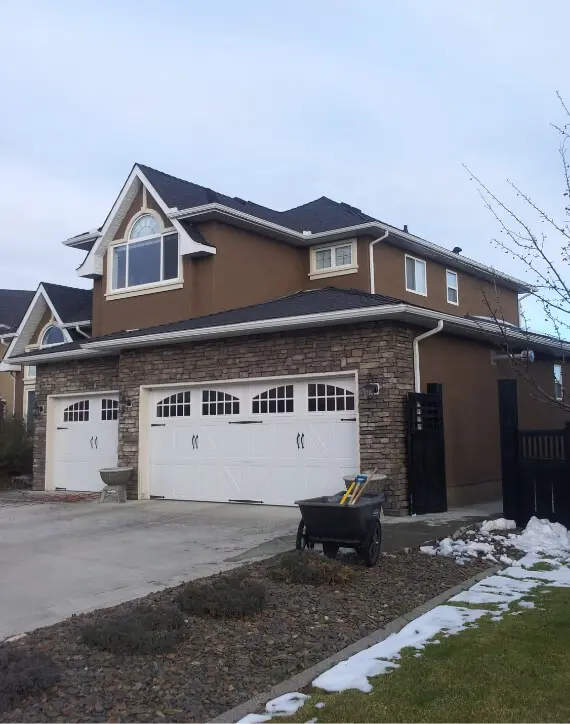
Eavestroughs carry roof water to the downspouts, the fascia closes the roof edge behind them, and the soffit closes the overhang and lets intake air into the attic. In Calgary they fail from ice, hail, debris and worn sealant. Four 2025 quotes priced new 5-inch seamless eavestrough and downspouts on a house and garage at $1,650 to $4,350 before GST.
Quick facts
- Eavestrough replacement. $1,650, $2,450, $2,500 and $4,350 before GST for 5-inch seamless trough and downspouts on a house and garage, in four 2025 quotes.
- 6-inch trough. One 2025 quote for 6-inch seamless eavestrough and downspouts on a house and garage came to $3,850.
- Fascia. $350 and $450 to replace damaged fascia in two 2025 quotes; $9.75 per linear foot over 110 ft in a third.
- Soffit. One 2026 quote priced standard aluminum soffit for a house and shed at $3,480, as part of a re-siding job.
- Repair. One 2024 quote to strip and re-seal the eavestrough corners on five buildings came to $4,850.
- Downspout discharge. The City of Calgary says eavestroughs and extensions should drain at least 1.2 to 1.8 m (4 to 6 ft) from the house.
- Bylaw distance. Calgary’s Stormwater Bylaw requires downspouts to end at least 2 m (6.6 ft) from any sidewalk, road, pathway, alley, lane or surface drainage facility.
- Intake air. The National Building Code calls for 1 sq ft of vent area per 300 sq ft of insulated ceiling, about half of it low on the roof, which on most houses means the soffit.
What do eavestroughs, fascia and soffit each do?
Each part has one job: the eavestrough moves water, the fascia closes and finishes the roof edge, and the soffit closes the overhang and ventilates the attic. The Canadian Roofing Contractors Association (CRCA) glossary defines a gutter as the trough at the eaves that conveys rain water from the roof to a downspout, and a fascia as any cover board at the edge or eaves of a flat or sloping overhanging roof. CertainTeed defines the soffit as the finished underside of the eaves, and soffit vents as the vents under the eaves that provide air intake.
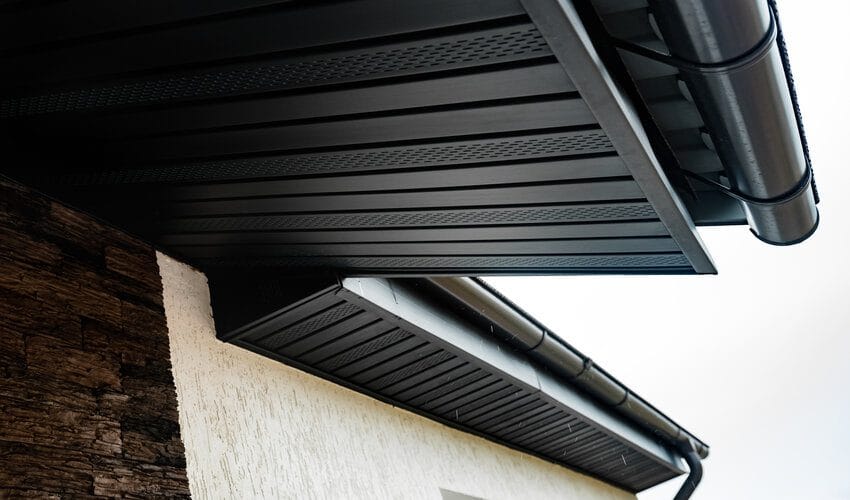
Owens Corning recommends drip edge on all roofs covered with asphalt shingles, with the shingles overhanging it by 1/4 to 3/4 in. The drip edge carries water off the deck in front of the fascia, and the trough below catches it. The fascia is also the board the eavestrough normally fastens to, so a rotten fascia leaves the trough with nothing sound to hang on.
The soffit is part of the roof’s ventilation, not trim. CertainTeed states that a properly designed system must have intake vents in the soffit or eaves at the lower part of the attic and exhaust vents high on the roof. Its installer manual adds three rules that concern the soffit directly:
- insulation must not be installed over the soffit intake area, or airflow into the attic is impeded;
- soffit vents must be installed evenly along all soffits;
- the net free area of vented vinyl or aluminum soffit panels must be checked, so that intake balances exhaust.
Owens Corning’s maintenance guide says to remove insulation blocking the soffit vents, not to paint over vents, and to make sure dryer and bathroom fans do not discharge into the attic or a soffit vent. A soffit replacement that swaps vented panels for solid ones can leave the attic short of intake.
Where should the water go once it leaves the roof?
It should reach the ground away from the foundation and the neighbours, without crossing a lower roof on the way. The City of Calgary says a house without eavestroughs and downspouts should have them installed, and that eavestroughs and extensions should drain at least 1.2 to 1.8 m (4 to 6 ft) away from the house, directed away from the foundation and the neighbours’ homes. Extensions must not be connected to the sanitary sewer line or the weeping tile, because the extra water can overload the pipes and flood the basement.
The Stormwater Bylaw adds a limit at the other end. Downspouts must end at least 2 m (6.6 ft) from any sidewalk, road, pathway, alley, lane or surface drainage facility, and the City says they should point toward the front or back of the property so runoff can drain to the lane or street. On a narrow lot both distances have to be met at once, so downspout locations belong in the quote.
Upper roofs need their own path down. Malarkey recommends against draining one roof directly onto another, and quotes the Asphalt Roofing Manufacturers Association: never allow water from a downspout to discharge directly onto a roof below. Owens Corning says the same, because the discharge causes premature granule loss, and both makers want the upper downspout connected to the lower eavestrough. One 2025 Calgary leak repair included exactly that fix, extending a downspout down to the lower eavestrough.
How do eavestroughs, soffit and fascia fail in Calgary?
Most failures trace to ice, hail, debris or sealant, and each leaves a different mark.
| What fails | What it looks like | Source of the problem | What Calgary quotes and manufacturers show |
|---|---|---|---|
| Corner and end-cap seals | Dripping at the corners | Old sealant no longer bonded to the metal | A 2024 quote removed loose sealant, cleaned the corners and re-coated them on five buildings, to be done in warm weather |
| Dented trough | Dents along the trough and downspouts | Hail | Owens Corning lists dents in gutters among the telltale signs of hail; a 2025 hail estimate replaced the whole system |
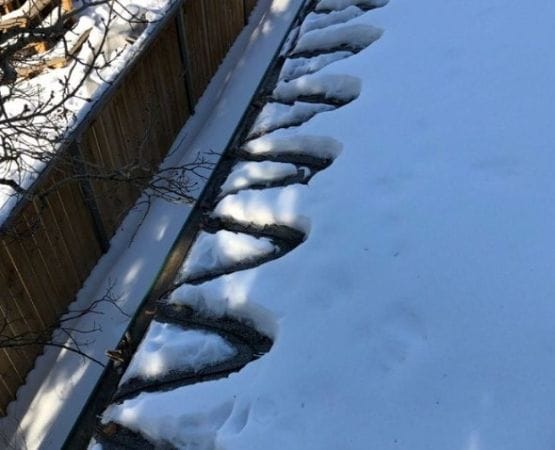
| Ice in the trough | Icicles, ice behind the fascia | Meltwater refreezing at the cold eave | CertainTeed: water backs up under shingles or behind fascia boards, and a falling ice dam can damage gutters and fascia |
| Clogged or sagging trough | Water standing or spilling over the front | Leaves, needles and roofing debris | Malarkey lists clogged, sagging or leaking gutters as a sign of trouble; CertainTeed warns aluminum gutters can buckle under tear-off debris |
| Overflow at a valley end | Water sheeting past the trough | Concentrated flow from the valley | A 2025 repair added lead flashing at a valley end and a metal guard so water stopped spilling toward the neighbour |
| Missing or short diverters | Runoff missing the end of the trough | Flashing that does not kick water into the trough | A 2024 quote supplied new diverters across a multi-building complex |
| Rotten fascia | Peeling paint, decayed board | Water behind the board | A 2023 quote replaced rotten fascia board around a whole house |
| Soffit staining or blocked intake | Peeling paint under the overhang, dampness in the attic | Water backing up at the eave, or insulation over the vents | Malarkey lists peeling paint in soffits as a warning sign; Owens Corning says to clear insulation from soffit vents |
Calgary adds scale to two of these. The Insurance Bureau of Canada reported that the hailstorm of August 5, 2024 produced over 130,000 insurance claims and more than $3 billion in insured damage, and that almost one in five homes in the city was affected. Eavestroughs record a strike: Owens Corning tells inspectors to look for dents in gutters and other metal when the shingle damage is not yet visible. Chinook thaws drive the second: each warm spell sends meltwater to an eave that is still frozen. CertainTeed names insulation, ventilation and waterproofing underlayment as the defences, and all three sit above the trough. For ice already in place, Owens Corning says to use steam or heating cables and no sharp metal tools.
When is a repair enough, and when does replacement make sense?
Repair is enough when the trough is straight and firmly attached and the fault is a seal, a diverter, a downspout or one short length. Replacement makes sense when hail has dented the runs, when the trough has pulled away from rotten fascia, or when you are having the roof or siding redone anyway.
National Star Roofing starts soffit and fascia work with an at-home assessment. Once we know the level of work, you get a free estimate for the scope, and our crew completes the installation, repair or replacement.
Calgary quotes show both paths. On the repair side: corner seals stripped and redone on five buildings for $4,850, diverters added across the same complex for $1,250, a downspout extended to a lower trough inside a $4,260 two-leak repair, and an eavestrough guard added inside a $3,285 repair that also replaced a plumbing boot. The last two are lump sums, so the eavestrough part has no price of its own.
On the replacement side, six of the seven eavestrough replacements in the files were priced beside larger work: three with a shingle re-roof, one with a flat roof replacement, one with other exterior repairs and one with new siding. Only the 2024 job stood alone. Two of the re-roof quotes also replaced damaged fascia. With a re-roof, the crew, access and disposal are already on site, and the same crew can set the drip edge and trough to each other.
Three limits apply to repairs:
- Sealant ages. One contractor’s 2026 terms note that sealants deteriorate faster than other materials and need regular inspection and maintenance.
- Warranty is shorter. The same terms, written for multi-unit buildings, give 10 years of workmanship warranty on full roof replacements, 5 years on soft metal and siding projects, and none on partial replacements or repairs.
- The shingle warranty does not help. Owens Corning’s standard warranty excludes roof damage or leaks caused by improperly designed or installed gutter or downspout systems.
Hail damage is an insurance matter. Policies differ, so ask your insurer whether eavestroughs, downspouts, soffit and fascia are covered, and what deductible applies.
What does eavestrough, soffit and fascia replacement cost in Calgary?
A full 5-inch eavestrough and downspout replacement on a house and garage ran $1,650 to $4,350 before GST in 2025, with three of the four quotes at $2,500 or less. The figures below come from estimates and quotes that Calgary roofing contractors wrote between 2022 and 2026, most for properties in the city and a few in nearby communities. Twelve of those documents priced eavestrough, soffit or fascia work as its own line.
| Work | Year | Price before GST |
|---|---|---|
| 5-inch seamless eavestrough and downspouts, house and garage, old system removed and hauled away | 2025, four quotes | $1,650; $2,450; $2,500; $4,350 |
| 6-inch seamless eavestrough and downspouts, house and garage | 2025 | $3,850 |
| Two 5-inch continuous aluminum eavestroughs with downspouts, plus 57 ft of perforated aluminum gutter guard | 2024 | $2,370 |
| 5-inch eavestrough with 2 1/2 by 2 1/2 in downspouts, house and shed, with a re-siding job | 2026 | $3,690 |
| Standard aluminum soffit, same house and shed | 2026 | $3,480 |
| Fascia, same house and shed | 2026 | $1,575 |
| Damaged fascia torn out and replaced, added to a re-roof | 2025, two quotes | $350; $450 |
| Fascia removed and replaced, 110 ft | 2025 | $9.75 per ft ($1,072.50) |
| Drip edge removed and replaced, 110 ft | 2025 | $4.50 per ft ($495) |
| Rotten fascia board replaced around a whole house | 2023 | $1,200 |
| 34 ft of 2x6 fascia board | 2022 | $250 ($200 labour, $50 material) |
| Eavestrough corners stripped and re-sealed, five buildings, upper and lower roofs | 2024 | $4,850 |
| Diverters supplied and installed, same complex | 2024 | $1,250 |
Three points help you read the table.
- No lengths. None of the eavestrough replacement quotes printed the length of trough or the number of downspouts, so no per-foot rate can be drawn from them. The spread from $1,650 to $4,350 most likely reflects house size, storeys and downspout count, which the quotes do not record.
- One soffit price. The $3,480 soffit figure is a single example from one property, and the old soffit, fascia and eavestroughs were removed under the siding line of the same quote.
- Per-foot fascia. At $9.75 per ft, 110 ft of fascia cost $1,072.50, which sits close to the $1,200 whole-house price from 2023. The same quote also priced 170 ft of custom-bent aluminum at $38.75 per ft without saying where it went, so it is not counted as fascia here.
Alberta adds 5% GST and no provincial sales tax.
What should an eavestrough, soffit and fascia quote spell out?
It should give sizes, lengths and discharge points, because the quotes reviewed mostly gave one line and one price. Ask for:
- Trough. Width (5 or 6 in), seamless or sectional, metal and colour, and the linear feet.
- Downspouts. Size, count and where each one ends, checked against the City’s 1.2 to 1.8 m and 2 m distances.
- Old system and seals. Removal, haul-away, and sealed corners and end caps, which the 2025 quotes all listed.
- Fascia. Linear feet, wood board or metal cover, and the rate for rot found once the old trough is off.
- Soffit. Vented or solid panels, and the net free area of the vented ones.
- Drip edge. Whether it is replaced, and how the shingle edge will sit over the new trough.
- Guards and diverters. Length, type and location.
- Warranty. The workmanship term for soft metal work, which may be shorter than for a roof.
How often should eavestroughs be cleaned?
Clean them whenever debris builds up, and check them before winter and before hail season. Owens Corning says to remove organic debris from the roof at least twice a year or any time a build-up is noticed, and to make sure gutters are properly attached and free of debris. Malarkey asks for leaves and needles to be removed from roofs, valleys and especially gutters, with a last check before winter so nothing hinders drainage. The Insurance Bureau of Canada lists clearing eavestroughs of debris among its steps to prepare for hail season, and the City of Calgary gives the reason: rainwater that cannot drain can accumulate and seep into the basement.
Most re-roof quotes reviewed for this guide include cleaning or air-blowing the eavestroughs at the end of the job at no separate charge, and none prices cleaning on its own. Book sealant repairs for warm weather, as the 2024 quote specified.
What this means for a Calgary roof
Calgary gives the roof edge two hard seasons. Winter chinooks send meltwater to a frozen eave again and again, so a trough that holds water or a soffit that starves the attic of intake air shows up as ice and stained fascia. The Insurance Bureau of Canada puts hail season in Alberta and the Prairies at June until September, and the August 2024 storm alone brought more than 130,000 claims. The City’s rules then decide where the water may go: 1.2 to 1.8 m clear of the house and 2 m back from sidewalks and lanes. National Star Roofing can inspect your trough, fascia, soffit vents and downspout discharge and quote repair and replacement side by side; call (403) 477-7712.
Questions people ask
How much do new eavestroughs cost in Calgary?
Four 2025 Calgary quotes priced new 5-inch seamless eavestrough and downspouts on a house and garage at $1,650, $2,450, $2,500 and $4,350 before GST, with the old system removed. One 6-inch system came to $3,850. None printed the trough length, so compare bids by linear foot.
How much does it cost to replace soffit and fascia?
The quotes reviewed for this guide hold one soffit price: $3,480 before GST for standard aluminum soffit on a house and shed in 2026, with fascia at $1,575 on the same job. Elsewhere, damaged fascia cost $350 to $450 as a re-roof add-on, and $9.75 per linear foot on one 2025 quote.
Can eavestroughs be repaired instead of replaced?
Yes, when the trough is straight and well attached. A roofer can strip and re-seal corners, add diverters and extend downspouts. One 2024 quote re-sealed the corners on five buildings for $4,850. Hail-dented runs and troughs hung on rotten fascia are replaced.
Where should downspouts drain in Calgary?
The City of Calgary says at least 1.2 to 1.8 m (4 to 6 ft) from the house, away from the foundation and neighbouring homes. The Stormwater Bylaw also requires downspouts to end at least 2 m (6.6 ft) from sidewalks, roads, pathways, lanes and surface drainage facilities, and never into the weeping tile.
Do I need a permit to replace eavestroughs in Calgary?
The City of Calgary’s storm-repair guidance states that a permit is not required to replace or repair eavestroughs or downspouts, or roofing materials. The guidance does not mention soffit or fascia, and it says replacing siding with a different material needs a building permit, so confirm with the City when the job goes beyond like-for-like replacement.
How often should eavestroughs be cleaned?
Owens Corning says to clear organic debris from the roof at least twice a year or whenever it builds up, and Malarkey asks for a last check before winter. A workable Calgary schedule is after the leaves fall and again before hail season, when the Insurance Bureau of Canada advises clearing eavestroughs.